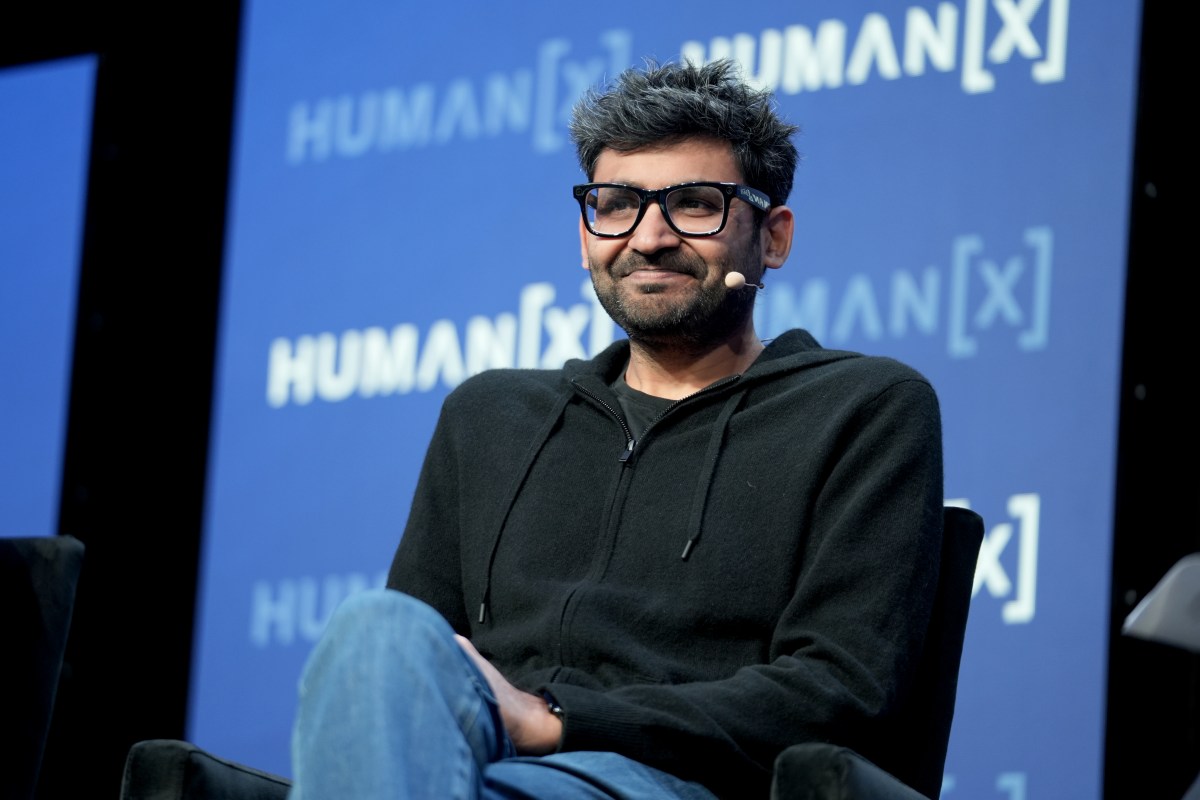


At Web Summit, there’s a moment when a production staffer — significantly larger than Laurent Mekies — casually puts a strong arm around the Oracle Red Bull Racing CEO’s shoulders, guiding him toward the sound console to get his phone for a photo. Most executives running organizations of 2,000 people would be put off by such informality, even from a devoted fan. Instead, Mekies smiles, his attitude remaining the same as he obliges the awestruck crew member.
It’s a brief moment, but it might reveal something about Mekies, who, just four months prior, became only the second person to head Red Bull Racing in its two-decade history.
“My first feeling is one of privilege, of being honored to suddenly be part of such an amazing team,” Mekies tells me later on stage, his English tinged with a French accent. “This team has been more successful in Formula One than any other in the past two decades. And then suddenly, you find yourself part of it.”
“Suddenly” is not an exaggeration. As widely reported, the completely unexpected offer came in July. Christian Horner, the outspoken executive who had been at Red Bull’s helm since its F1 entry in 2005, was out. Mekies, who had been managing the team’s sister organization, Racing Bulls, for a little over a year, was chosen to take over.
In some ways, Mekies was an unlikely candidate. While Horner enjoys the media attention and strategic maneuvering that characterize F1 team principals, Mekies has spent much of his career immersed in engineering. His approach to achieving victory also reflects this technical grounding; he identifies performance improvements not only in areas like aerodynamics and tire technology but also in streamlining workflows and processes.
This philosophy extends to the team’s collaborations. Consider 1Password, the cybersecurity firm whose CEO, David Faugno, is seated next to Mekies and me on the Web Summit stage. Faugno assumed leadership of his own well-known brand four months ago — the same week as Mekies.
The alliance between a cybersecurity company and an F1 team might seem unusual. After all, security often implies added steps: passwords to remember, systems to verify, and workflows that can slow things down. In F1, where even thousandths of a second can make a difference, this is unacceptable.
However, this is precisely why Mekies views 1Password as crucial to Red Bull’s competitive advantage. “Our team members must manage, log in to, and log out of intricate systems — in aerodynamics, vehicle dynamics at the track, back at the factory, in the simulator, and in the wind tunnel. Today, with this seamless login and logout process facilitated by the security level, we are moving faster than we were before.”
Techcrunch event
San Francisco
|
October 13-15, 2026
It’s a minor competitive edge, but in F1, these advantages accumulate. “You are pursuing the smallest competitive advantage, one at a time,” Mekies points out. “Our tech experts, our people — they constantly challenge us regarding the distractions that are somewhat unavoidable in a large team. With 1Password, we have a solution that reduces these distractions, freeing up more time for our core activities, and that’s ultimately where performance gains come from.”
From engineer to CEO
At 48, Mekies has experienced Formula 1 from almost every perspective. After studies at ESTACA, an engineering school in Paris, and Loughborough University in the U.K., he started in Formula 3 in 2000 before joining F1 with a British racing team called Arrows in 2001. He then moved to Minardi, an Italian team, in 2003 as a race engineer. When Red Bull acquired the struggling team and rebranded it as Toro Rosso in 2006 — with the aim of creating a junior team to nurture young drivers like Max Verstappen for Red Bull Racing — Mekies was promoted to chief engineer.
Mekies remained there for eight years before transitioning to the role of safety director at the Fédération Internationale de l’Automobile (FIA), the regulatory body for Formula 1 and other motorsport series globally. There, he reportedly championed the titanium safety structure positioned above the driver’s cockpit in Formula 1 cars to safeguard the driver’s head — known as the “halo” system. Following that, he joined Ferrari as deputy race director, and five years later, he returned to Red Bull’s junior racing team (which was renamed Racing Bulls in 2024).
In short, Mekies brings a wide array of experience to the role. What he doesn’t bring — at least not yet — is a significant ego. When Verstappen secured victory at the 2025 Italian Grand Prix at Monza in September, marking the fastest race in F1 history, reporters inquired about Mekies’ contribution to the win. His response was modest: “I made zero contribution.” When the reporters laughed, he added, “I’m serious.”
When I bring up that moment during our conversation at Web Summit, Mekies simply shrugs. “All we do as leaders is empower our people to showcase their talents. So, it’s very much their victory.”
Mekies views his role differently from his prominent predecessor. He isn’t intentionally trying to “lead from behind.” Instead, he tells me on stage that he doesn’t “believe the approach is what matters. I don’t think it’s about leadership style. You’ll find every style imaginable in leadership. I think what truly matters is caring for the people and fostering a care-for-the-company culture.”
Indeed, while Mekies could certainly lavish attention on his star driver (Mekies wants to keep him, after all), he’s more focused on the team. “Your immediate thoughts go to the 2,000 individuals back at the factories who never gave up on this season,” he says. “It requires a tremendous amount of energy and a strong company culture to maintain that level of motivation and fighting spirit.”
Humility doesn’t equate to playing it safe, though. The Monza victory also validated a somewhat surprising decision: to continue developing the 2025 car instead of abandoning it for the following year’s development. “We were not pleased with the car’s performance at the beginning of this year and through the middle of it,” Mekies tells me. “We decided to continue pushing with 2025. We didn’t think we could simply move on and expect everything to be better next year.”
It was a risky move. With completely new regulations set to arrive in 2026 — including new chassis rules and power unit regulations — most teams had already redirected resources to the following year’s car. However, Mekies believed his team needed to understand the issues before progressing. “We felt we had to understand what hadn’t been working,” he says. “We perhaps pushed harder than some of our competitors. And fortunately, it led to this turnaround in form.”
Now, the team heads into winter with less development time than its competitors, “but with significantly more faith in our resources, our methods, and our processes,” Mekies says.
Driving forward
If Mekies’ 2025 turnaround was risky, 2026 represents something different: a “crazy adventure,” as Mekies describes Red Bull’s initiative to build its own power unit for the first time, in partnership with Ford. (It has relied on Honda-based engines since 2019.) “For Oracle Red Bull Racing, next year can only be described as a crazy challenge. That’s how significant it is for us.”
To understand the scale of what the team is undertaking, here’s how Mekies explains it on stage: “We are going to create our own power unit with support from Ford, and we will be competing against companies that have been manufacturing Formula One engines for over 90 years. This is the kind of ambitious endeavor that only Red Bull would attempt. We’ve decided to build facilities from scratch in the middle of a field in Milton Keynes [a large town about 50 miles northwest of London] — constructing the building, installing the dynos [which are large, sophisticated test rigs], hiring 600 people, getting them to collaborate, and ultimately creating an engine and getting it ready for the track.”
Can he guarantee Verstappen a championship-winning car next year? When I ask Mekies, he answers directly. “It would be foolish to expect to immediately be at the right level. That’s not going to happen,” he says. “But we’re approaching it the Red Bull way. We’re taking it with the high-risk, high-reward approach that we value.”
He has reason for optimism. Currently third in this year’s F1 team standings, just behind Mercedes, Red Bull has a realistic chance of overtaking them for second place in the final three races of this year’s season. It’s a departure from the dominance Red Bull has enjoyed in recent years, but given the season’s start, it would represent a significant recovery.
Backstage, before our conversation, as makeup artists apply powder for the stage lights, I ask Mekies about the pressure of those final races. His response is characteristically methodical.
“We always emphasize taking it race by race. That’s what we’ll do in the next three races,” he tells me. “You want to arrive at the racetrack, get the car into the optimal range,” referring to the specific conditions where a car performs best, “and compete for the win.”
It’s “incredibly challenging to compete at that level,” he continues, “but everyone in Milton Keynes has been doing a tremendous job of improving the car and providing us with a competitive package for the season’s end.”
In the meantime, he insists he’s not focused on the points tables or hypothetical scenarios. “We’re not looking at the numbers. We’re aware of the developments in the [F1 team standings], but we’re only concentrating on each race as it comes.”
That’s the “only thing we do,” he says, describing Red Bull’s objective: “Chasing lap times.”