A nationwide scarcity of air traffic controllers has focused attention on an expanding training option the FAA now sanctions for select colleges.
The recent federal government shutdown underscored the stretched staffing levels, particularly as delays and reroutings accumulated nationwide.
The FAA aims to recruit a minimum of 8,900 new controllers by 2028. FAA workforce data, analyzed by USAFacts, indicates approximately 3,000 controller positions were unfilled nationally as of late 2024, although understaffing varies across facilities.
This shortage is fueling interest in a more recent FAA-approved college track designed to expedite controller training at a limited number of universities, including Middle Georgia State.
KRISTI NOEM UNVEILS $1B TSA MODERNIZATION PLAN, AWARDS $10K BONUSES TO WORKERS WHO SERVED DURING SHUTDOWN
The Enhanced AT-CTI program enables students to train to the same standard as the FAA Academy. If hired and meeting FAA criteria, such as passing the Air Traffic Skills Assessment (ATSA), medical and security clearances, they can proceed directly to a facility, bypassing the full academy in Oklahoma City, which may involve lengthy waitlists and multi-month courses.
Graduates still undergo facility-specific training and must achieve on-the-job certification before becoming fully qualified controllers.
As of 2025, only about nine schools nationwide have received approval to offer the new Enhanced AT-CTI program, according to Kemarie Jeffers, the department chair of aviation science and management at Middle Georgia State.
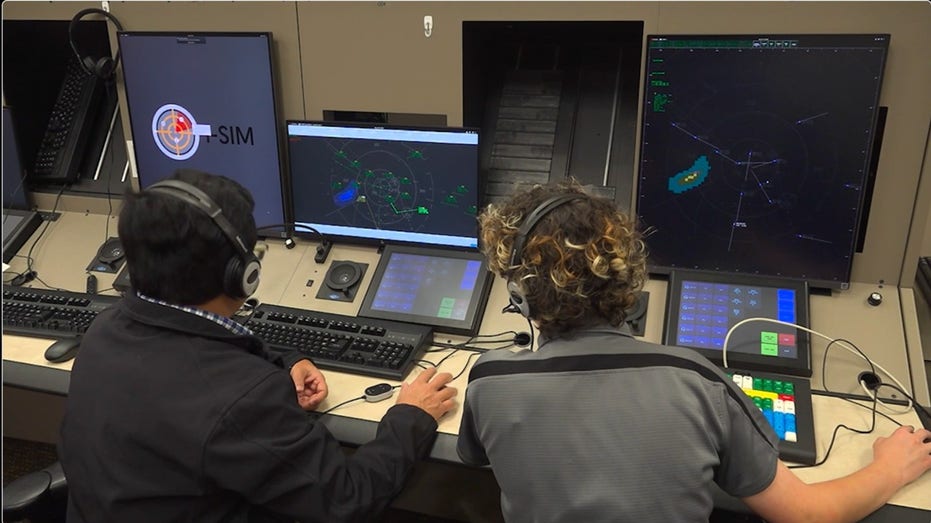
Inside Middle Georgia State’s tower simulator, air traffic control student Brooke Graffagnino expresses that the job’s intensity is what attracted her. “It kind of gets your chest beating, because with how much traffic there is, sometimes it is intense,” she stated.
HOUSE DEMOCRAT SIDES WITH TRUMP OFFICIALS ON AIR TRAFFIC CUTS AMID SHUTDOWN CHAOS
She notes that students quickly determine their suitability for the role. “You can kind of tell who does not [love it]. There have been quite a few, and they are no longer here. It takes a lot to get through it,” she mentioned.
Graffagnino explains that the importance of the work became clearer as she learned how controllers maintain order in busy airspace. “Once you get in the airspace that is super crowded or approaching the larger airports like Atlanta, you need someone to help coordinate and keep everything separate and safe,” she elaborated.
Middle Georgia State gained approval as an Enhanced AT-CTI school in mid-2024. Jeffers indicates the impact was immediate.
“Before our program had maybe about 17 to 20 students. Right now we have 54. So we have already, in that short amount of time, almost tripled in size the amount of students that we have,” he shared.
To secure the enhanced designation, Jeffers stated the school had to revise its curriculum, revamp portions of its simulator setup, and install new audio and video systems.
“We’ve upgraded a lot of our equipment… we had to install audio and video equipment upstairs in our tower sim,” he noted.
These upgrades enable the FAA to remotely inspect or audit training sessions, ensuring adherence to federal standards.
FAA TO LIFT EMERGENCY FLIGHT RESTRICTIONS MONDAY MORNING AS AIR TRAFFIC STAFFING REBOUNDS
The program’s primary distinction lies in what transpires post-graduation. “Enhanced CTI eliminates your requirement of going to the academy. You will graduate here and you can go straight to work,” Jeffers explained. “So it saves you time and effort — again, it gets you to work sooner and making money quicker.”
The FAA mandates that enhanced programs employ instructors with controller experience and maintain simulator equipment on par with FAA standards.
As students progress, the simulations escalate in complexity, requiring trainees to manage a greater number of aircraft simultaneously.
“As we get more comfortable and confident, we are able to allow more aircraft into the airspace at a time,” Graffagnino commented.
Prior to completing the program, each student must pass a final simulation that mirrors the FAA Academy’s evaluation process.
“Our instructors will then run a scenario and they will be graded… the exact same way in which they will be graded at the academy,” Jeffers clarified.
According to the FAA’s FY 2025 Air Traffic Controller Workforce Plan, the agency projects roughly 2,000 hires in FY 2025, 2,200 in FY 2026, and gradual increases through 2028, although retirements are anticipated to offset a significant portion of that growth.