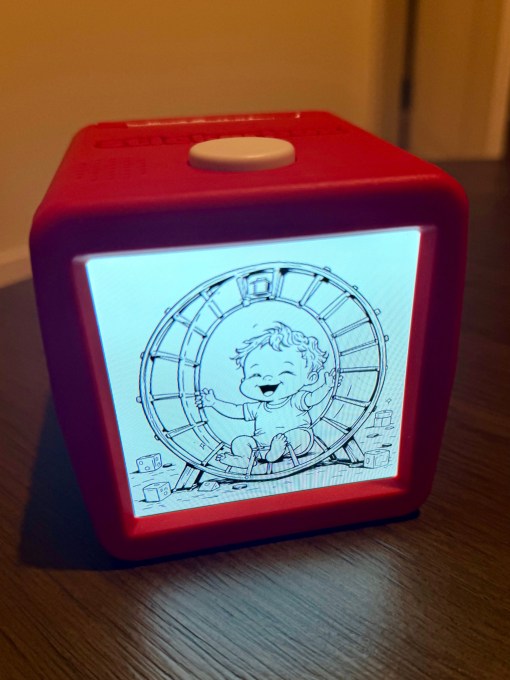
A new AI-driven toy called Stickerbox is available for children, and before you roll your eyes, I’m here to say that it’s surprisingly enjoyable.
Stickerbox, a creation of Brooklyn-based startup Hapiko, functions as a sticker printer activated by voice. The gadget takes any imaginative concept you have and turns it into a sticker that is printed, ready for coloring, peeling, and placement anywhere.
I must admit I had a preconceived skepticism before actually using the device, as did my co-tester (my daughter). Our first thoughts were similar: “An AI that prints stickers? I’d prefer designing and printing my own.”
But after using the review device provided by the company, we changed our minds.
I came to the conclusion that Stickerbox might introduce a novel approach to imaginative play, one that, contrary to expectations, does not overly depend on an AI model to fuel a child’s creativity.

Testing the AI sticker printer
The toy, priced at $99.99, is essentially a small, vibrant red box with a black-and-white display screen and a prominent, white “push-to-talk” button on its upper surface. It comes with a set of colored pencils, a power cable, and three paper rolls, good for 180 stickers.
The box’s color design brings to mind the Etch A Sketch, which is fitting because the Stickerbox feels like a contemporary interpretation of that idea. To create an image with the Etch A Sketch, you must learn to use different knobs. With Stickerbox, these “knobs” are substituted with something more conceptual: the spoken commands that trigger the AI model.
Naturally, children aren’t focused on improving their prompt engineering skills; instead, they’re exploring their creativity and having fun watching their ideas materialize. Any improvement in their prompting skills is just a bonus.
A parent will need to assist with the device’s initial setup. Similar to adding a smart speaker to your home’s Wi-Fi network, you must first connect to the Stickerbox’s Wi-Fi and then input the details to connect to your home network. The setup was quick, taking only a minute, and proceeded without problems.

Using a Stickerbox is easy. To see your text appear on the screen, push the button, verbally describe an image, and then let go of the button. Next, an AI-generated image is printed, and the physical copy is ejected.
The experience of imagining something and then holding it physically in your hands just seconds later has a certain serendipitous appeal.
Since the device uses a thermal image printer, no ink is needed. Also, the paper is BPS and BPA-free, making it safe for use.
You can easily detach the printed sticker to color it with the colored pencils that are provided with the device. Crayons and markers of your own will also work. The experience combines the thrill of conceiving new things to print with the more soothing, meditative aspects of coloring, much like when children use a coloring book.
Ultimately, it struck a good mix between using technology, which has the potential to be addicting, and engaging in a real-world activity that required slowing down. It also helped to alleviate potential boredom.

You will realize how complex your prompts may be the more you use the Sitckerbox. You are not limited to requesting a basic image, such as a “magical unicorn”; you can use lengthy, stream-of-consciousness commands to communicate with the Stickerbox, and the AI will decipher what you mean. (Since children typically don’t explain things simply, this is very helpful.)
Making “AI for Kids”
Hapiko, the company that created Stickerbox, was established this year by CEO Arun Gupta and CTO Robert (Bob) Whitney. The two first became acquainted while employed at the e-commerce marketplace Grailed, where Whitney held the position of director of engineering and Gupta served as CEO. (In 2022, the company was acquired by GOAT Group.)
Prior to Grailed, Gupta established and introduced WakeMate, a hardware sleep tracker supported by Y Combinator.

Whitney, in the meantime, held the post of engineering director at The New York Times’ Games division as the publisher broadened its offerings beyond just crosswords to become a comprehensive gaming app through the acquisition of Wordle and the launch of further games like Connections and Strads. Although he learned a great deal about what makes a successful consumer-facing product from that experience, his subsequent position at Anthropic gave him firsthand knowledge of developments in AI technology.
However, his experience as a parent served as the catalyst for Stickerbox.
He used ChatGPT to create a printable image when his son requested a coloring page that he didn’t have on hand.
Whitney recounted, “I made it for him—a tiger eating ice cream. He had never seen a printer before. I took our HP brother printer out from under the bed, literally dusted it off and printed it for him, and he joyfully ran off and started coloring it. But a minute later, the wheels were turning, and he came back to me, and he said, ‘I want a lizard riding a skateboard.’ And I was like, okay, cool, let me make that for you.”
His son was so happy about being able to verbalize something and see it come to life that he understood the potential of the idea.
Whitney remarked, “I just witnessed this magical expression on his face—pure magic.”
The co-founders were also considering how AI technology made so many new experiences possible, but the majority of them were not designed for children.
Gupta stated, “No one is developing AI specifically for kids. That is what we are searching for. What are the appropriate safeguards? What are the proper methods? What are the appropriate products?”

They came to the conclusion that children have wonderful imaginations, which makes them perfect for working with an AI image model.
Gupta stated, “[They have] unlimited imagination and creativity; they are constantly learning new things. They develop a new obsession every week. I believe we are truly the first people in the world to include an image model inside of a box.”
Built for Updates
The Stickerbox uses a number of AI models, including proprietary technology designed to make the device child-safe. It won’t fulfill requests for offensive content like violence or sexually explicit images, and it will block swear words. Additionally, if you try a somewhat harmless command, like “boobs,” it will simply print a random sticker that may or may not be relevant to the word. (As an example, you might get a generic cartoon girl, but not one with large breasts.)
Most kids will probably go back to just asking the device for silly pictures after trying unsuccessfully to get a naughty result.
Gupta stated, “We want to be the reliable brand for parents so they don’t have to constantly look over their children’s shoulders and wonder, ‘what are they doing? How are they using this?'”
The company currently makes some money from device sales, but it keeps the price of paper refills low. Three rolls, or 180 stickers, only cost $5.99. (Currently, they are running a promotion that includes six rolls with every purchase.)
The team intends to investigate incorporating premium features over time, such as the option to upload your own image to envision yourself in fantastical scenarios or collaboration tools.
The Stickerbox is updated frequently with new firmware and features because it is a Wi-Fi-enabled device. For example, during testing, we were able to print some recognizable characters, but a more recent update added new safeguards to encourage children to create more original designs.
A companion app that will be released soon will also let you see previous works and save favorites; it may eventually act as the home for premium features.
Stickerbox has received $7 million in funding from Maveron, Serena Williams’ Serena Ventures, the Allen Institute’s AI2 incubator, and a number of angel investors, including Matt Brezina and product executives from other consumer apps.