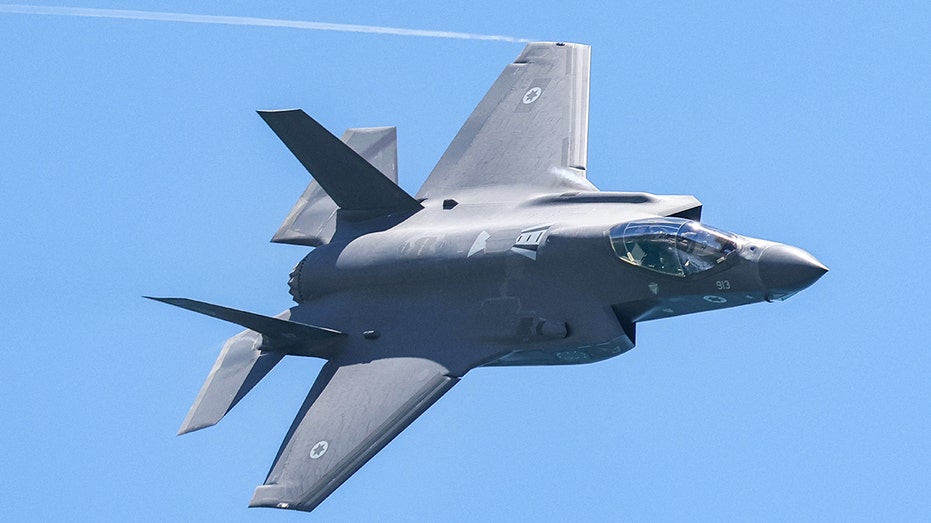
Experts and retired senior military commanders suggest that China’s intense efforts to pilfer American military technology are becoming a key issue in the discussion about whether the U.S. should sell F-35 fighter jets to Saudi Arabia.
(Ret.) Gen. Charles Wald, a former deputy commander of EUCOM and U.S. Air Force officer, stated that the U.S. had already turned down the United Arab Emirates and Turkey because of worries about Chinese technology exploitation.
Wald stated, “We informed Turkey that they would not receive the F-35. We informed the UAE that they would not receive it because of concerns about the potential transfer of technology to China. The biggest problem with Saudi Arabia receiving the F-35 would likely be that… Not that they would give it to the Chinese, but that the Chinese could use intelligence to exploit and obtain capabilities from it. However, I am not as concerned as some others are.” Wald made these remarks during a briefing at JINSA this week.
SAUDI CROWN PRINCE BIN SALMAN RAISES HIS US INVESTMENT COMMITMENT TO ALMOST $1 TRILLION
According to China expert Gordon Chang, Beijing has already proven its capacity to infiltrate U.S. defense programs and should be presumed to be targeting the F-35 once more. Chang stated to Fox News Digital, “We should assume China already possesses everything. They had already stolen the entire plane once and probably did so again.”
He asserted that Washington needs to weigh the risks against the strategic advantages of closer ties with Riyadh. He stated, “We must strengthen our relationship with the crown prince, especially if doing so helps him approve an Abraham Accord. Allow him to possess stripped-down F-35s.”
He continued by saying that other U.S. allies could pose even greater risks. “I’m far more concerned about South Korea possessing the plane and handing over the plans to China.”
For years, Chinese intelligence agencies have been linked to attempts to obtain American military and aerospace technology, including stealth designs, propulsion systems, and sophisticated avionics. U.S. authorities have previously connected Chinese cyber actors to thefts aimed at top-tier American defense programs, including parts resembling those utilized in fifth-generation fighters.
AMERICA’S ‘BAT’ MAN REVEALS TECHNOLOGY DESIGNED TO OUTWIT A CHINESE FIRST STRIKE
Against this backdrop, the United States is considering whether to approve Saudi Arabia’s request for the F-35 as part of broader negotiations that include defense assurances and potential diplomatic advancement with Israel.
(Ret.) Lt. Gen. Robert Ashley, former director of the Defense Intelligence Agency, stated that although the United States employs foreign military sales monitoring protocols to lower risk, the protections are not foolproof. Ashley stated, “One of the things we do through foreign military sales is end-use case monitoring protocol. We closely monitor how these kinds of advanced systems are used, but they are not absolute.”
SAUDI ARABIA IS ALREADY AMERICA’S BIGGEST ARMS BUYER, AND NOW TRUMP WANTS TO ADD F-35S
The retired commanders stated that, despite the threat posed by China, they do not think a Saudi F-35 acquisition would jeopardize Israel’s qualitative military edge.
Wald emphasized that Israeli pilots, planners, and engineers maintain a superior level of training and innovation. Wald stated, “The actual pilot capability of the Israelis is far superior to that of other countries.” He continued by saying that Israel has incorporated its own enhancements into the aircraft. “The Israelis made minor adjustments to their own F-35… they developed [additional capabilities] shortly before the attack on Iran.”
Wald pointed out that Riyadh would not receive the aircraft for several years, even if it were approved. He stated, “At the very least, if they acquired the F-35, there would probably be a five-year window before that occurred.”
Ashley and Wald stated that having more F-35s in the area in the long run could improve shared situational awareness and fortify joint defenses against Iran. According to retired Vice Adm. Mark Fox, the fighter’s data-sharing architecture means that having more aircraft in the hands of allies improves overall performance. Fox stated, “The F-35’s ability to communicate with every other F-35 is a key feature. The coalition’s capability is increased by having more F-35s in the region.”