
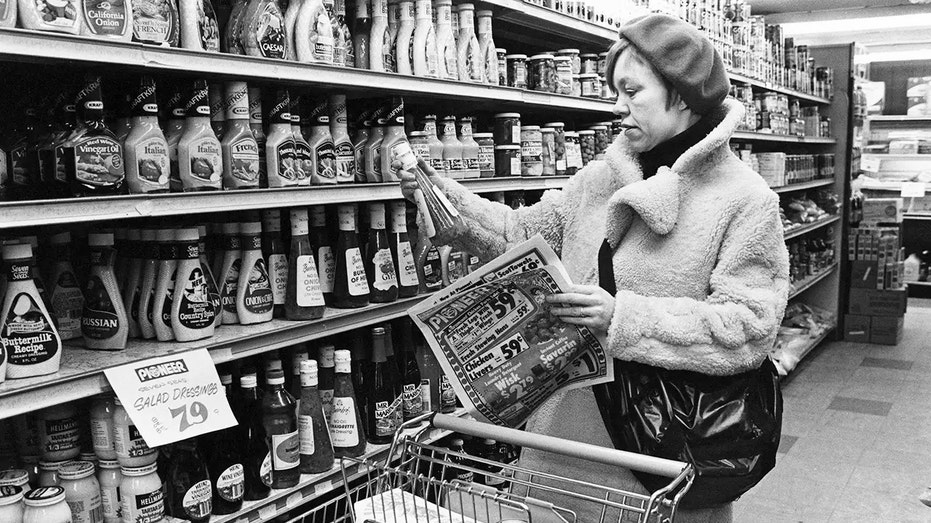
For decades, zesty, smooth and original mixtures characterized the American salad experience.
However, in this era of avocado-lime ranch and green goddess, many classic dressings have gradually vanished from store aisles and dining tables.
Yet, nostalgic home cooks are preserving the classics, recreating and sharing their interpretations and relishing the memories associated with them.
WHAT BECAME OF OLIVE LOAF, THE NOSTALGIC 1970S DELI MEAT THAT AMERICA ABANDONED?
“Catalina is reminiscent of family stories and the holidays,” one Reddit user quipped in a recent r/Old_Recipes discussion about the 1960s-era favorite.
Another remembered, “Hot bacon dressing — it smelled strange, but everyone enjoyed it.”
Someone else stated, “Spinach salad with hot bacon dressing was the elegant salad of my childhood. … It seemed very special!”
Here are seven vintage dressings that once reigned supreme in American refrigerators.
Trademarked by the Louis Milani Foods Co. in 1954, Buccaneer dressing was promoted as an “exciting dressing [that] brings a sense of adventure to salads, sandwiches [and] cooked vegetables,” according to Chowhound.
2,000-YEAR-OLD ROMAN RECIPES BROUGHT BACK TO LIFE — HERE’S WHAT THEY ACTUALLY TASTE LIKE
It was well-liked until the 1970s, when Louis Milani Foods, now Kent Precision Foods, stopped producing it.
While the precise taste and original recipe seem to have disappeared over time, fans remember that its zesty, savory and subtly umami flavor came from mayo, honey mustard, garlic powder and paprika.
Distinct from the similar creamy, pink-toned Thousand Island, Louis dressing offers a tangy kick with Worcestershire sauce, lemon juice, horseradish and hot sauce.
It is the defining element for the Pacific Northwest’s renowned Crab Louie salad, but its slight spiciness and tang make it a flexible choice for seafood salads.
SPAGHETTI RECIPE WITH UNEXPECTED HOLIDAY TWIST GOES VIRAL: ‘PARTY FOR YOUR TASTE BUDS’
Crab Louis traces back to a 1912 recipe in the Portland Council of Jewish Women’s Neighborhood Cookbook. It was served with lettuce and hard-boiled eggs, with early versions appearing on menus in San Francisco as well as Portland, Oregon, and Spokane, Washington, throughout the early 20th century, Chowhound reported.
A St. Louis, Missouri, creation with roots connected to both the 1904 World’s Fair and the Mayfair Hotel, Mayfair dressing has long confused food experts with its conflicting history.
“There’s a dressing that I’ve only experienced in St. Louis, called Mayfair dressing, created for the 1904 World’s Fair,” one Redditor recalled fondly. “It’s like a celery-focused Caesar.”
The dressing substitutes Parmesan with raw celery and onion, giving it a textured consistency with an anchovy-rich foundation.
TEST YOURSELF WITH OUR LATEST LIFESTYLE QUIZ
“If you enjoy celery, it’s really delicious,” said another commenter.
Boiled salad dressing, a Southern classic, was prepared by cooking eggs, flour, mustard and vinegar over a double boiler to produce a sauce resembling a mix of mayonnaise and hollandaise, according to food news website The Takeout.
The sauce provided a peppery, vinegary taste that made it a favorite for substantial salads and vegetable dishes. Its lack of oil made it an inexpensive option.
“Boiled dressing!” one Reddit user exclaimed. “SO incredible. It’s somewhere between sweet and savory. … Think of lemon curd but using mustard and vinegar rather than lemon.”
Originating in Central and Eastern Europe, sour cream dressing is diluted with lemon juice or vinegar, enhanced with Dijon mustard and sometimes sweetened with sugar and paprika, creating dressings that excel on potato or egg salads.
CLICK HERE TO SIGN UP FOR OUR LIFESTYLE NEWSLETTER
It serves as a foundation for many home cooks, who enhance it further with fresh herbs or green onions.
Tomato-based dressings once contributed a burst of color and tang to mid-century salads, highlighted by Kraft’s Catalina dressing of the 1960s.
Made with tomato purée, vinegar, sugar and spices, these dressings inspired subsequent favorites such as bacon and tomato dressing.
CLICK HERE FOR MORE LIFESTYLE STORIES
Meanwhile, Nebraska’s Dorothy Lynch dressing, developed in the 1940s using tomato soup, shows that tomato-based dressings have a history extending beyond French dressing.
As one social media user fondly remembered, a tomato soup-based dressing was the highlight of numerous church potlucks in the 1960s.
Along with Catalina, poppyseed and celery seed dressings also once dominated supermarket shelves through the 1970s, each providing a unique interpretation of “sweet and tangy.”
Celery seed dressing, dating back to the 1960s, is a combination of oil, vinegar, sugar, mustard and celery seeds. Poppy seed dressing, made popular in the 1950s, blends sugar, vinegar, mustard, onion and oil with poppy seeds.
“My mother used to prepare celery seed dressing from her ‘Better Homes and Gardens’ 1965 cookbook. It’s essentially a poppy seed sweet-sour dressing made from scratch, but using celery seed instead,” one Redditor remembered. “Very tasty.”