
Sam Basu quit his job as a senior software engineer at Google in early 2023, not long after OpenAI released ChatGPT. He took a few stabs at starting new AI businesses, but nothing really stuck until he got a call from a friend who wanted help filling out customs paperwork.
Basu got “very curious” and started cold-calling customs brokers in the Los Angeles area. He learned that many are mom-and-pop affairs still deeply reliant on fax machines and paper. When his first customer showed him stacks of manila folders during a FaceTime tour of her office, everything clicked, Basu told TechCrunch. He flew to that customer’s office the next day.
“That was the eye-opening moment. There’s just papers and papers,” Basu said in a recent interview. “I was both shocked and impressed. Shocked that this is how the industry runs, and impressed that everything around us, from the watch that you’re wearing to the glasses, literally everything that’s imported, and this is what’s happening behind the scenes.”
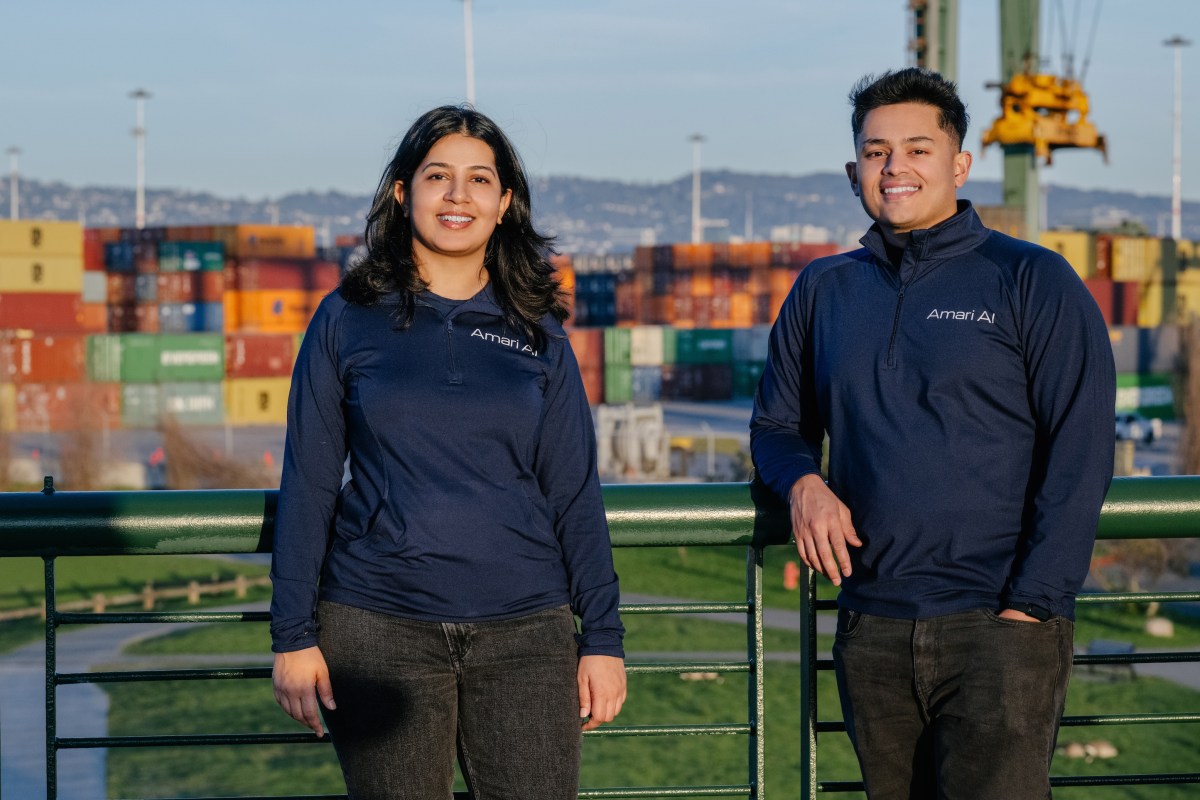
This seed of an idea is now called Amari AI, a startup co-founded by Basu and Arushi Vashist, a former senior software engineer at LinkedIn. The pair, and their small team, have already collected more than 30 customers, and helped those firms move more than $15 billion of goods.
Amari has also raised $4.5 million of funding co-led by preeminent early-stage firms First Round Capital and Pear VC, all before coming out of stealth mode on Thursday.
Basu has two goals with Amari. One is to help customs brokers modernize. To date, he said, many of them have done little work to integrate new technologies. Some leverage optical character recognition software to help speed up data entry, but that tech is limited and brittle, he said. Amari is meant to help automate data entry and paperwork, and let employees — who legally must be in the United States, meaning companies can’t use off-shore workers — focus on helping customers move their goods across the border.
That’s where the second goal comes in. President Donald Trump’s chaotic trade policy has made customs brokers all the more important, according to Chris Bachinski, CEO of 125-year-old firm GHY International. Bachinski — who is one of Amari’s early adopters — told TechCrunch that many of his own customers don’t even have their own compliance staff. Instead, they look to the brokers like GHY to help figure out how sudden changes in trade policy apply to their goods, especially if they are already in transit.
Techcrunch event
Boston, MA
|
June 23, 2026
This chaos has led to burnout across the industry, according to Basu. With the employee base tightly regulated, and a licensing exam pass rate that hovers around 10% to 20%, “it’s a perfect fit for AI,” he said.
“Experienced people are leaving the industry or taking early retirement,” Basu said. “So we’re pitching ourselves as these extra set of hands that logistics companies can hire or keep alongside the human expertise.”
Basu said Amari’s AI agents constantly monitor trade rules and update their reasoning any time there’s a change, making it easier for brokers to help their customers quickly understand any impact. Previously, these kinds of sudden changes required manual research that would slow down brokers’ ability to clear cargo into the country.
Amari does this by building its own AI models trained on more than one million documents related to the shipments it’s already helped clear through customs, though Basu said the company has been leveraging off-the-shelf models to date. He noted some customers do opt out of this training, and that Amari anonymizes the data before feeding it to the models.
“We do not sell their data, and we make sure that their data is theirs,” he said. “They’re very serious about these documents.”
Todd Jackson, a partner at First Round Capital, attributed Amari’s early success to Basu’s willingness to pound the pavement in order to learn what these brokers need.
“He’s going to conferences, he’s going to trade shows, [and] the word of mouth starts to get very strong,” Jackson said in an interview. “It’s an old-school industry.”
It was at one of these trade shows — the National Customs Brokers and Forwarders Association of America, to be precise — that one of Basu’s presentations caught Bachinski’s eye. GHY International is not a mom-and-pop, but it’s also not a Fortune 500 like FedEx; Bachinski has been looking for ways to both stay competitive and grow his company.
Bachinski said the biggest concern amongst GHY employees so far has been job loss. But he’s told them not to worry. He said he expects tech like Amari’s to help GHY grow, and to focus more on the customer relationships and compliance work.
“It’s an old industry, and technology is going to shift our industry faster than I think most customs brokers understand,” he said. And with trade now constantly in the spotlight, he said brokers need to be agile. “I make this joke that last year, the first time in history, our families know what we do for a living. Because all of a sudden, custom brokers became very, very important.”